
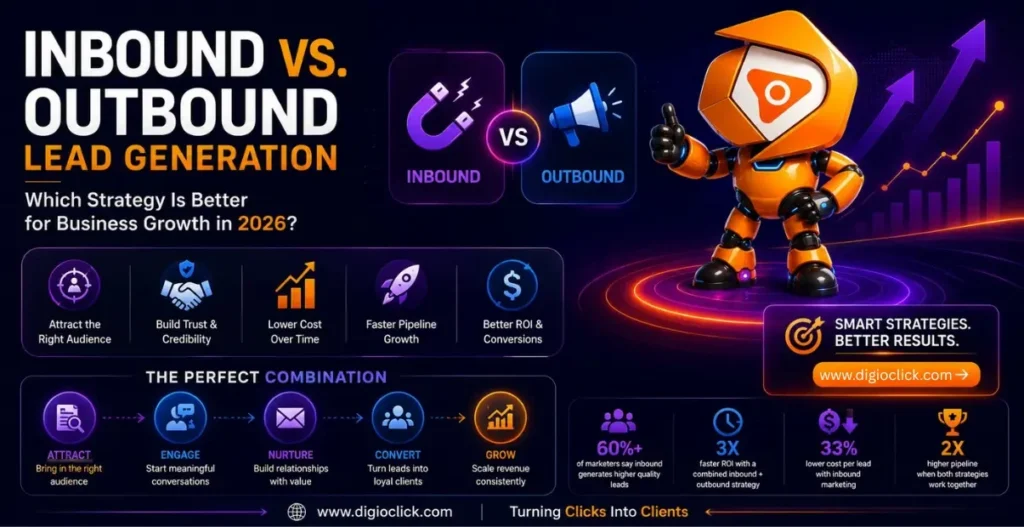
Lead generation is the foundation of sustainable business growth, helping companies attract potential customers and convert them into loyal clients. In today’s competitive market, businesses primarily rely on two strategies: inbound lead generation, which attracts prospects through valuable content and SEO, and outbound lead generation, which reaches potential customers through proactive methods like cold emailing, cold calling, and LinkedIn outreach. Both approaches offer unique advantages, but choosing the right one depends on your goals, budget, and target audience. In this article, we’ll compare inbound vs. outbound lead generation, explore their key differences, benefits, and ROI, and help you determine the best strategy for growing your business in 2026.
What’s Lead Generation?
To put it simply, lead generation refers to the processes that lead potential consumers to become customers. Businesses both small and large will typically depend on lead generation in order to continue to make a profit. Through lead generation many businesses face various challenges in the sales process including the problem of not having a fresh stream of leads.
Today’s consumers are more informed than ever before. This means that they can engage in research about potential products before buying them. In this regard, the concept of lead generation has also changed. Now there are two main types of lead generation available to companies: inbound (when the customers seek information about a company) and outbound (when the sales people do direct outreach).
Understanding inbound lead generation
Lead generation through inbound marketing refers to gaining clients from content and experiences relevant to their needs. Unlike traditional marketing methods, inbound marketing helps potential clients to find companies and services without disrupting their activities with ads or cold calls.
The main strategies employed in the process of inbound marketing lead generation involve SEO, blogs, webinars, downloadable material, newsletters, social media, podcasts, and videos.
Studies show that inbound marketing is more cost-efficient than traditional outbound marketing. Several reports demonstrate that inbound leads require significantly fewer costs and are able to provide better-quality leads over the long term.
How Inbound Works
- A visitor finds your blog through Google.
- They read helpful content.
- They download a guide.
- They subscribe to your newsletter.
- Marketing nurtures them through email.
- Sales engages once they’re ready.
- Instead of chasing customers, inbound allows customers to come to you.
The Fundamentals of Outbound Lead Generation
Outbound lead generation refers to the process of reaching out to prospects before they have shown any interest. The sales team picks certain companies, finds the right contacts in those companies, and then starts communicating via cold emails, cold calls, LinkedIn messages, flyers, advertisements, or meeting people at trade shows for instance.
Outbound marketing differs from inbound marketing in that it allows one to have control over the pipeline right from the start. Therefore, outbound marketing is a tactic that generates leads faster especially if ideal customers are not currently looking for the company’s products or services online.
The definition of modern outbound means that the technique is not simply about mass sending out emails. Proficient outbound marketers practice various techniques in marketing like an account-based marketing method, intent information, and personalization by implementing several communication channels at once to achieve the maximum effectiveness of their outbound marketing campaigns.
Inbound vs. Outbound Lead Generation Comparison
| Feature | Inbound | Outbound |
| ————— | —————— | ——————– |
| Lead Source | Customers find you | You find customers |
| Initial Cost | Moderate | Moderate to High |
| Long-Term ROI | Excellent | Moderate |
| Time to Results | Slow | Fast |
| Trust Level | High | Lower initially |
| Scalability | Excellent | Depends on team size |
| Brand Building | Strong | Limited |
| Predictability | Builds over time | Immediate pipeline |
One of the biggest differences lies in timing. While outbound can quickly fill your sales schedule in only a few weeks, inbound typically takes a few months to start creating regular, reliable traffic and leads. That said, in the long run, inbound can often prove to be more cost-efficient, since the content continues attracting new prospects long after it was published.
Advantages of Inbound Lead Generation
Inbound marketing allows companies to build up assets over the long-run. Each piece of web content — blogs, landing pages, case studies, videos — continues to serve the company long after they have been published. While advertising campaigns stop delivering the flow of prospective buyers when the budgets are spent, search-engine-optimized content keeps attracting new, qualified customers.
Another significant advantage of inbound marketing is trust. Customers would like to do their own research first and only then come to the sales department. Content marketing helps your company establish itself as an industry expert, which makes customers more “open” to your sales pitch.
Continued industry studies indicate that inbound marketing has a lower cost-effectiveness, a higher level of productivity and a better conversion rate as compared to the traditional outbound marketing methods. Organic search remains one of the largest sources of website traffic for businesses worldwide.
Advantages of Outbound Lead Generation
Even though it is true that outbound marketing has hardly any advantage over inbound methods regarding getting new clients, it is very beneficial when companies need to grow quickly.
If your company has launched a new product, is moving into a new region, is targeting enterprise customers or is using account-based marketing, waiting for six months for SEO results is not an option.
Outbound marketing gives the ability to companies to directly connect with decision-makers.
* Reach decision-makers directly
* Test new markets quickly
* Control pipeline volume
* Personalize outreach
* Generate meetings immediately
Numerous B2B companies continue to depend substantially on outbound strategies for enterprise sales because major corporations require more proactive efforts rather than waiting for prospects to come to them. However, cold calling and customized outreach have shown to have potential provided that they’re executed properly and strategically.
Problems with Both Strategies
Neither of these strategies is perfect.
Inbound needs patience, constant content creation, Search Engine Optimization skills and further optimization. The companies that expect quick results often abandon inbound strategy too early.
Outbound involves other problems as cold calling becomes ineffective when there’s lack of targeting. Cold calls and emails are receiving lower response rates and buyers are becoming more reluctant towards broad sales pitches. Again, the main and critical factors include research, personalization and persistence.
Businesses sticking to only one approach are risking too much. For example, a change in search engine algorithms would lead to lower efficiency of the inbound approach, while new regulations in email service may seriously damage outbound strategy.
Which Strategy Proves to Be More Efficient?
The answer will depend on the timing.
When the goal is achieving sales in a month or two, the outbound strategy would be typically a better option.
Though, when the goal is establishing a lead generation system within several years, inbound strategy is usually more effective.
When Should You Choose Inbound?
Inbound is ideal when:
* Building long-term authority
* Investing in SEO
* Growing organic traffic
* Reducing customer acquisition costs
* Creating sustainable lead generation
* Selling through education
Businesses in professional services, SaaS, agencies, the healthcare sector, and tech firms are able to get great results with inbound marketing largely due to the research that buyers conduct before making a decision.
When Should You Choose Outbound?
Outbound works best when:
* Launching new products
* Targeting enterprise accounts
* Building pipeline quickly
* Entering unfamiliar industries
* Running account-based marketing campaigns
* Selling High-Value B2B Solutions
In most cases, businesses that provide specialized services use outbound marketing to get in touch with executives who are not necessarily looking for services online but match the customer profile.
Why the Most Successful Companies Use an Integrated Approach
Companies that perform well don’t tend to rely solely on one channel.
They tend to combine outbound and inbound marketing together in a single machine that works for sales.
For example:
- SEO attracts prospects researching solutions.
- Blogs build credibility.
- Case studies demonstrate expertise.
- Email nurturing educates leads.
- SDRs reach strategic target accounts.
- LinkedIn outreach increases brand awareness.
- Sales department deals with potential customers who have shown high interest in the offer.
Despite the fact that the B2B marketers are talking about how the combination of quality content and targeted outbound marketing tops any single channel.
The Most Effective Methods for Lead Generation in 2026
Those businesses that are best at growing are focused on quality rather than quantity.
The following points should be considered best advice:
Formulate an accurate Ideal Customer Profile (ICP).
Confirm that both the marketing and sales teams are collaborating properly.
Make sure to put money into both search engine optimization and informative content.
Use buyer research to personalize your cold outreach.
Use marketing automation to help with your lead nurture process.
Analyze your performance with the help of CRM tools.
Incorporate AI into the existing communication channels rather than replacing human agents with it.
Continue improving your digital assets, including landing pages and emails..
Monitor cost of lead, contribution to pipeline, and customer lifetime value.
Companies that thrive are the ones that practice inbound and outbound as complementary strategies rather than competing strategies.
Conclusion - Lead Generation
The question of inbound vs. outbound lead generation should not be about identifying a single victor. These techniques have different objectives in the acquisition funnel.
Inbound is the best choice for building faith, achieving continuous organic traffic, and reducing acquisition costs as time goes by. Outbound is fast and accurate and allows for the proactive development of ambitious prospects, who may never find your company on their own.
In the case of B2B companies, the best results are usually achieved when both approaches are combined. Inbound is used for creating standing and raising demand, while outbound goes for speeding up the pipeline creation stages. Organizations that skillfully combine approaches can get a steady flow of leads, raise conversion and generate revenue.
FAQ's - Lead Generation
1. Inbound VS outbound lead generation – the basic distinction?
Inbound lead generation attracts potential customers through valuable content, search engine optimization, social media, and other types of organic marketing strategies. In contrast, outbound lead generation requires the company to reach prospects proactively.
2. Which of these lead generation methods is the best for B2B businesses?
There is no universal answer to that. Inbound is ideal for tackling tasks connected with brand authority and organic traffic, whereas outbound is good for generating sales immediately. However, successful B2B businesses usually opt for a blend of both methods.
3. Is inbound lead generation cheaper than outbound lead generation?
Yes, inbound lead generation is considered much cheaper in time because content creation and search engine optimization can work long after being produced. On the other hand, outbound techniques may require regular investments to yield good results.
4. How soon should inbound lead generation produce results?
Usually, inbound lead generation takes around 3–6 months to give its results. This period can vary according to industry, competition, and particular content strategy used.
5. Is outbound lead generation a viable technique in 2026?
Yes. In today’s world, outbound lead generation is an effective technique when campaigns are tailored to the specific prospects. Methods such as account-based marketing (ABM), cold emails, LinkedIn outreach, and sales prospecting are still useful sources for generating qualified B2B leads.